Charitable foundations must be flexible and innovative in preparing the United States for an unprecedented era of change, former Republican House Speaker Newt Gingrich told a gathering of the country's philanthropic leaders in Pittsburgh.
"We may be facing the largest scale of change since Abraham Lincoln in 1861," said Mr. Gingrich, whose half-hour speech marked the end of the Washington, D.C.-based Council of Foundations' three-day conference.
The conference attracted about 1,600 of the country's top philanthropists, who [among other things] heard Mr. Gingrich label poverty, education and the rise of India and China as evolving issues that will shape America's future.
"Either America changes itself very substantially in its capabilities, or we cease to be the leading country in the world. There is no third alternative."
[Excerpt of an article by Ryan Haggerty, The Pittsburgh Post-Gazette]

5/10/06
Canadian tax change good for charity
Donations to Canadian charities could rise by as much as $500-million annually because of a tax change announced in the recent federal budget.
The budget calls for the elimination of capital gains tax on donations of publicly traded securities to charities. Currently, if shares are donated, 25 per cent of any capital gain on the stock, after it has been sold by the charities, must be included in a donor's income. The change, which is effective immediately, means that no capital gain has to be included in income.
The stock donations still receive the same tax credits based on the value of the stock donated. In total, the measure will provide substantially more tax incentive for donations of securities than cash.
[Excerpt of article by Paul Waldie, The Globe and Mail (Toronto)]
The budget calls for the elimination of capital gains tax on donations of publicly traded securities to charities. Currently, if shares are donated, 25 per cent of any capital gain on the stock, after it has been sold by the charities, must be included in a donor's income. The change, which is effective immediately, means that no capital gain has to be included in income.
The stock donations still receive the same tax credits based on the value of the stock donated. In total, the measure will provide substantially more tax incentive for donations of securities than cash.
[Excerpt of article by Paul Waldie, The Globe and Mail (Toronto)]
5/9/06
Soros pumps millions into global change
Billionaire financier George Soros, of the Open Society Institute, will address the 57th annual Council on Foundations conference. The council is a trade association for more than 2,000 philanthropic programs worldwide.
According to an event program, Soros is scheduled to speak on "the innovative ways that the Open Society Institute is changing lives across the globe." Soros "will share how creative grantmaking and partnerships can effect change that is far-reaching and sustaining," the program states.
According to its Internet site, the Open Society Institute aims to shape public policy to promote democratic governance, human rights and economic, legal and social reform. It oversees a network of nearly 30 national foundations, most in Eastern Europe.
The institute was founded in 1994 by Soros, 75, the controversial liberal activist who two years ago donated $24 million to various political groups in a failed attempt to derail President Bush's re-election.
[Excerpt of article by Eric Heyl, The Pittsburgh Tribune-Review]
According to an event program, Soros is scheduled to speak on "the innovative ways that the Open Society Institute is changing lives across the globe." Soros "will share how creative grantmaking and partnerships can effect change that is far-reaching and sustaining," the program states.
According to its Internet site, the Open Society Institute aims to shape public policy to promote democratic governance, human rights and economic, legal and social reform. It oversees a network of nearly 30 national foundations, most in Eastern Europe.
The institute was founded in 1994 by Soros, 75, the controversial liberal activist who two years ago donated $24 million to various political groups in a failed attempt to derail President Bush's re-election.
[Excerpt of article by Eric Heyl, The Pittsburgh Tribune-Review]
5/8/06
The Threat of Affordable Medicines
Some of the larger developing countries, such as Thailand, India, Brazil, and Egypt have tried to do something about the high pricing of medicines.
India’s successful pharmaceutical industry, built on its patent laws that allow the development of very cheap generic drugs has been under threat from WTO property rights rules on patent protection, and pressure from the large pharmaceutical companies.
Brazil made a bold, but important move to produce AIDS drugs themselves, but at the same time, breaking the patent rights of Swiss pharmaceutical company, Roche.
Furthermore, a subsequent global AIDS fund set up by the U.N. also led to warnings of concern at things like patents, pricing and so on, which is captured well by Philippe Riviére, who is worth quoting at length:
"The Indian firm Cipla’s offer to MSF [Médecins Sans Frontiéres] to provide a cocktail of antiretrovirals for less than $350 a year (compared to the big boys' $10,000) resounded like a thunderbolt. "
— Philippe Riviére, Southern Sickness, Northern Medicine; Patently Wrong, Le Monde Diplomatique
India’s successful pharmaceutical industry, built on its patent laws that allow the development of very cheap generic drugs has been under threat from WTO property rights rules on patent protection, and pressure from the large pharmaceutical companies.
Brazil made a bold, but important move to produce AIDS drugs themselves, but at the same time, breaking the patent rights of Swiss pharmaceutical company, Roche.
Furthermore, a subsequent global AIDS fund set up by the U.N. also led to warnings of concern at things like patents, pricing and so on, which is captured well by Philippe Riviére, who is worth quoting at length:
"The Indian firm Cipla’s offer to MSF [Médecins Sans Frontiéres] to provide a cocktail of antiretrovirals for less than $350 a year (compared to the big boys' $10,000) resounded like a thunderbolt. "
— Philippe Riviére, Southern Sickness, Northern Medicine; Patently Wrong, Le Monde Diplomatique
5/7/06
The Constant Gardener not “just a movie”
A number of recent posts focus on the uncaring attitudes of the pharmaceutical industry. So how much is hype and how much is real?
For readers who may not have seen the recent movie "The Constant Gardener", a pharmaceutical company tests dangerous drugs on unsuspecting Africans. The Washington Post today reports a case where Pfeizer gave an unproven drug to nearly 100 children.
The drug in question is banned in Europe and severely restricted in the States. So where do they test a drug like that? –Africa.
”Pfizer contended that its researchers traveled to Kano with a purely philanthropic motive, to help fight the epidemic, which ultimately killed more than 15,000 Africans.
“The [investigating] committee rejected that explanation, pointing out that Pfizer physicians completed their trial and left while 'the epidemic was still raging.'
“Pfizer's experiment was ‘an illegal trial of an unregistered drug,’ the Nigerian panel concluded, and a ‘clear case of exploitation of the ignorant.’
“The confidential report …was provided by a source who asked to remain anonymous because of personal safety concerns."
[Full Washington Post article, "Panel Faults Pfizer in '96 Clinical Trial In Nigeria"]
For readers who may not have seen the recent movie "The Constant Gardener", a pharmaceutical company tests dangerous drugs on unsuspecting Africans. The Washington Post today reports a case where Pfeizer gave an unproven drug to nearly 100 children.
The drug in question is banned in Europe and severely restricted in the States. So where do they test a drug like that? –Africa.
”Pfizer contended that its researchers traveled to Kano with a purely philanthropic motive, to help fight the epidemic, which ultimately killed more than 15,000 Africans.
“The [investigating] committee rejected that explanation, pointing out that Pfizer physicians completed their trial and left while 'the epidemic was still raging.'
“Pfizer's experiment was ‘an illegal trial of an unregistered drug,’ the Nigerian panel concluded, and a ‘clear case of exploitation of the ignorant.’
“The confidential report …was provided by a source who asked to remain anonymous because of personal safety concerns."
[Full Washington Post article, "Panel Faults Pfizer in '96 Clinical Trial In Nigeria"]
Why should the Pharmaceutical Industry care?
Some may argue that it should be up to those nations affected by such problems to invest in appropriate research, that the private corporations cannot be expected to solve all of the world’s problems and that it is unfair to point to such companies and criticize them as they would also go broke from such activities. However:
- The western nations that the corporations are based in have, through colonialism, and post-war global economics, fostered an environment that have led to further poverty and dependency of the poorer nations on the first world countries.
- Post war policies from the IMF and World Bank have forced most developing countries to cut back on such social expenditure as health and education, in the first place. Most countries are in a downward spiral due to their policies.
- Medical and pharmaceutical companies often tout their strengths of having vast capital resources to do research, bringing benefits to humanity the world over. Unfortunately though, tropical disease cures are not profitable for them because most people with such diseases are too poor to afford cures.
Incredible wealth of pharmaceutical companies
“There was a time not long ago when the corporate giants were merely the size of nations. Now, after a frenzied period of pharmaceutical mega-mergers, they are behemoths which outweigh entire continents.
“The combined worth of the world’s top five drug companies is twice the combined GDP of all sub-Saharan Africa and their influence on the rules of world trade is many times stronger because they can bring their wealth to bear directly on the levers of western power.”
— Julian Borger, Industry that stalks the US corridors of power, the Guardian.
“The combined worth of the world’s top five drug companies is twice the combined GDP of all sub-Saharan Africa and their influence on the rules of world trade is many times stronger because they can bring their wealth to bear directly on the levers of western power.”
— Julian Borger, Industry that stalks the US corridors of power, the Guardian.
5/6/06
Pharmaceutical companies and developing countries
While pharmaceutical companies have no doubt created life-saving drugs that have saved millions of lives, they have also participated in practices around the world that have come under a growing amount of criticism.
NGOs allege that the pharmaceutical corporations:
· sell products in developing countries that are withdrawn in the West;
· cause the poor to divert money away from essential items, such as foodstuffs, to paying for expensive, patented medicines, thereby adding to problems of malnutrition;
· promote antibiotics for relatively trivial illnesses;
· resist measures that would help governments of developing countries to promote generic drugs at low cost;
· use their home government to support their operation with threats if necessary, such as withdrawing aid, if a host government does anything to threaten their interests.
— John Madeley, Big Business Poor Peoples; The Impact of Transnational Corporations on the World’s Poor
[Excerts of research compilation by Anup Shah]
NGOs allege that the pharmaceutical corporations:
· sell products in developing countries that are withdrawn in the West;
· cause the poor to divert money away from essential items, such as foodstuffs, to paying for expensive, patented medicines, thereby adding to problems of malnutrition;
· promote antibiotics for relatively trivial illnesses;
· resist measures that would help governments of developing countries to promote generic drugs at low cost;
· use their home government to support their operation with threats if necessary, such as withdrawing aid, if a host government does anything to threaten their interests.
— John Madeley, Big Business Poor Peoples; The Impact of Transnational Corporations on the World’s Poor
[Excerts of research compilation by Anup Shah]
5/5/06
Why the awareness on AIDS, and not other diseases?
Of diseases in the Third World, AIDS is getting the most attention and focus. Not coincidentally, it is also one of the few diseases that remain a threat to First World countries.
— “Pharmaceutical companies put profits before needs”, Project Censored
As western nations realized they too were going to face the threat of AIDS, awareness was raised. Until recently, AIDS did not kill as many as some of the other major diseases, yet it receives more attention.
— “Pharmaceutical companies put profits before needs”, Project Censored
As western nations realized they too were going to face the threat of AIDS, awareness was raised. Until recently, AIDS did not kill as many as some of the other major diseases, yet it receives more attention.
Developing World not a profitable “market”
Multinational pharmaceutical companies neglect the diseases of the tropics, not because the science is impossible but because there is, in the cold economics of the drugs companies, no market.
There is, of course, a market in the sense that there is a need: millions of people die from preventable or curable diseases every week. But there is no market in the sense that, unlike Viagra, medicines for leishmaniasis are needed by poor people in poor countries.
Pharmaceutical companies judge that they would not get sufficient return on research investment, so why, they ask, should we bother? Their obligation to shareholders, they say, demands that they put the effort into trying to find cures for the diseases of affluence and longevity - heart disease, cancer, Alzheimer’s.
Of the thousands of new compounds drug companies have brought to the market in recent years, fewer than 1% are for tropical diseases."
In the corporate headquarters of major drug companies, the public relations posters display the image they like to present: of caring companies that bring benefit to humanity, relieving the suffering of the sick. What they don’t say, is that, so far, their humanity has not extended beyond the limits of the pockets of the sick.
--Isabel Hilton, A Bitter Pill For The World’s Poor, The Guardian
There is, of course, a market in the sense that there is a need: millions of people die from preventable or curable diseases every week. But there is no market in the sense that, unlike Viagra, medicines for leishmaniasis are needed by poor people in poor countries.
Pharmaceutical companies judge that they would not get sufficient return on research investment, so why, they ask, should we bother? Their obligation to shareholders, they say, demands that they put the effort into trying to find cures for the diseases of affluence and longevity - heart disease, cancer, Alzheimer’s.
Of the thousands of new compounds drug companies have brought to the market in recent years, fewer than 1% are for tropical diseases."
In the corporate headquarters of major drug companies, the public relations posters display the image they like to present: of caring companies that bring benefit to humanity, relieving the suffering of the sick. What they don’t say, is that, so far, their humanity has not extended beyond the limits of the pockets of the sick.
--Isabel Hilton, A Bitter Pill For The World’s Poor, The Guardian
5/4/06
Disease: An “unimportant” and ignored issue
The deepening poverty across the African continent has created fertile ground for the spread of infectious diseases. Declining living conditions and reduced access to basic services have led to decreased health status.
In Africa today, almost half of the population lacks access to safe water and adequate sanitation services. As immune systems have become weakened, the susceptibility of Africa’s people to infectious diseases has greatly increased.
Meanwhile, the amounts being paid by African governments to foreign creditors continues to increase. By the 1990s, most African countries were spending more repaying foreign debts than on health or education for their people.
In 1997, it was estimated that sub-Saharan African governments were transferring to Northern creditors 4 times what they were spending on the health of their people. In 1998, Senegal spent 5 times as much repaying foreign debts as on health.
The poverty and economic aspect of the various root causes of disease and health problems is less understood or discussed in mainstream media or various medical and scientific circles. Yet, poverty has been described as the number one health problem for many poor nations as they do not have the resources to meet the growing needs.
However, emphasis in the mainstream media and by pharmaceutical companies has been far more on cures rather than prevention.
In Africa today, almost half of the population lacks access to safe water and adequate sanitation services. As immune systems have become weakened, the susceptibility of Africa’s people to infectious diseases has greatly increased.
Meanwhile, the amounts being paid by African governments to foreign creditors continues to increase. By the 1990s, most African countries were spending more repaying foreign debts than on health or education for their people.
In 1997, it was estimated that sub-Saharan African governments were transferring to Northern creditors 4 times what they were spending on the health of their people. In 1998, Senegal spent 5 times as much repaying foreign debts as on health.
The poverty and economic aspect of the various root causes of disease and health problems is less understood or discussed in mainstream media or various medical and scientific circles. Yet, poverty has been described as the number one health problem for many poor nations as they do not have the resources to meet the growing needs.
However, emphasis in the mainstream media and by pharmaceutical companies has been far more on cures rather than prevention.
5/3/06
Cure for Neglected Diseases: Funding
A global push to tackle neglected diseases such as malaria and tuberculosis is gathering steam, largely because of an influx of charity money to subsidize the work of the drug companies.
A new report cites a wealth of donations and leadership from the Bill and Melinda Gates Foundation, Doctors Without Borders, the Wellcome Trust and the Rockefeller Foundation, all designed to create a new landscape for work on diseases afflicting poor countries.
Governments, including that of the United States, have started to help with modest donations.
But more than half the nearly $255 million contributed as of April 2005, the most recent available figure, had come from the Gates Foundation.
The U.S. government has contributed $16 million, dwarfed by the Gates Foundation's $159 million, the report said.
"Who's actually funding this is essentially Bill Gates," Mary Moran, principal author of the new report, said as she presented some of its findings at the Brookings Institution in Washington. "Now we need the public to step in and take it to the next stage."
[Excerpt of an article by Justin Gillis, Washington Post]
A new report cites a wealth of donations and leadership from the Bill and Melinda Gates Foundation, Doctors Without Borders, the Wellcome Trust and the Rockefeller Foundation, all designed to create a new landscape for work on diseases afflicting poor countries.
Governments, including that of the United States, have started to help with modest donations.
But more than half the nearly $255 million contributed as of April 2005, the most recent available figure, had come from the Gates Foundation.
The U.S. government has contributed $16 million, dwarfed by the Gates Foundation's $159 million, the report said.
"Who's actually funding this is essentially Bill Gates," Mary Moran, principal author of the new report, said as she presented some of its findings at the Brookings Institution in Washington. "Now we need the public to step in and take it to the next stage."
[Excerpt of an article by Justin Gillis, Washington Post]
5/2/06
Clinton: Compulsory AIDS tests
Former U.S. President Bill Clinton’s Clinton Foundation HIV/AIDS Initiative is helping to provide cheaper AIDS tests and drugs in developing nations.
The foundation has brokered deals with pharmaceutical companies to bring the price of an instant test for HIV, the virus that causes AIDS, down to between 49 and 65 cents, or about half the normal cost. It has also brought down by about 70 percent the prices of some anti-retroviral drugs that slow the spread of disease.
According to the Clinton Foundation, more than 90 percent of the 40 million people living with HIV do not know they are infected. "If 90 percent don't even know (they have the disease) how can you ever reduce the number of sufferers?" Clinton told reporters.
"They need to know their status," he said. Rapid HIV tests can do that even in remote areas because they're easy to use and give results in 20 minutes, the 59-year-old former president said.
Clinton said he supported the African kingdom of Lesotho, which is the first country that has pledged to introduce the compulsory testing of all its 2.2 million citizens, of whom 27 percent are HIV-positive.
He hope to tackle the stigma surrounding the disease, so more people will be tested voluntarily.
Asked for his perspective on his post-White House role, Clinton said: "Directly and indirectly, I can have influence ... by chain reaction I might do some good. Tens of thousands of kids are alive now that might not have been" without his foundation.
CNN
The foundation has brokered deals with pharmaceutical companies to bring the price of an instant test for HIV, the virus that causes AIDS, down to between 49 and 65 cents, or about half the normal cost. It has also brought down by about 70 percent the prices of some anti-retroviral drugs that slow the spread of disease.
According to the Clinton Foundation, more than 90 percent of the 40 million people living with HIV do not know they are infected. "If 90 percent don't even know (they have the disease) how can you ever reduce the number of sufferers?" Clinton told reporters.
"They need to know their status," he said. Rapid HIV tests can do that even in remote areas because they're easy to use and give results in 20 minutes, the 59-year-old former president said.
Clinton said he supported the African kingdom of Lesotho, which is the first country that has pledged to introduce the compulsory testing of all its 2.2 million citizens, of whom 27 percent are HIV-positive.
He hope to tackle the stigma surrounding the disease, so more people will be tested voluntarily.
Asked for his perspective on his post-White House role, Clinton said: "Directly and indirectly, I can have influence ... by chain reaction I might do some good. Tens of thousands of kids are alive now that might not have been" without his foundation.
CNN
5/1/06
Prince Harry launches AIDS charity
 Britain's Prince Harry launched his own charity in memory of his late mother, Princess Diana, to help children orphaned by AIDS in Lesotho. Harry, an army officer who is third in line to the throne, called the charity Sentebale which means "Forget me not" in Sesotho, the main language of Lesotho.
The prince, once dubbed the royal "wild child" for his youthful drug and drink antics, said of his new charity "As far as I am concerned, I'm committed for the rest of my life."
Harry announced the launch of the charity after his fourth trip to the tiny African kingdom, where up to one-third of the population are believed to be HIV positive and drought has caused serious food shortages.
Harry co-founded the charity with Lesotho's Prince Seeiso whose own mother, Queen Mamohato, died in 2003. Harry, speaking to reporters in a pooled despatch, said "Sentebale does mean 'Forget me not' and it's a way that both me and Prince Seeiso can relate to our mothers who were both in sort of the same jobs working with orphaned children."
"This particular charity, rather than aiming directly at AIDS itself, it's about the knock-on effect on the children, so we can actually help the kids."
[Reuters]
4/30/06
Strengthening human rights, addressing terrorism
Broad-based humanitarian change requires not just the work of human rights organizations, but of people helping people, says Larry Cox, the new executive director of Amnesty International USA.
Involving regular people in the fight for human rights is critical, especially during this time of heightened concern about terrorism.
"Human rights offers a different vision of how you can protect people, and that is to bring to justice those who are guilty of violent attacks while working to ensure all human rights, including economic, social, and political rights," Cox says. "The fulfillment of these rights protects us all by addressing the forces that typically attract people to become terrorists."
To create such change, Cox envisions a renewed emphasis on traditional grassroots organizing to bring about changes in public policy. In college and then as an antiwar worker in Paris in the 1960s, he learned first-hand many of the organizing techniques he envisions reviving at Amnesty, such as letter-writing and phone campaigns, engaging community groups, and organizing protests and marches.
[Excerpt of an article by Jane Savitt Tennen, Philanthropy Journal]
Involving regular people in the fight for human rights is critical, especially during this time of heightened concern about terrorism.
"Human rights offers a different vision of how you can protect people, and that is to bring to justice those who are guilty of violent attacks while working to ensure all human rights, including economic, social, and political rights," Cox says. "The fulfillment of these rights protects us all by addressing the forces that typically attract people to become terrorists."
To create such change, Cox envisions a renewed emphasis on traditional grassroots organizing to bring about changes in public policy. In college and then as an antiwar worker in Paris in the 1960s, he learned first-hand many of the organizing techniques he envisions reviving at Amnesty, such as letter-writing and phone campaigns, engaging community groups, and organizing protests and marches.
[Excerpt of an article by Jane Savitt Tennen, Philanthropy Journal]
4/29/06
African group to get $17 million Gates grant
In many parts of sub-Saharan Africa, it is the lack of street signs, addresses and even consistent spelling of family names that poses some of the greatest challenges to scientists seeking to test a new drug or vaccine.
The Bill & Melinda Gates Foundation is expected to announce a $17 million grant in support of an African-led initiative working to overcome such obstacles.
Drug companies or other organizations doing clinical research in Africa today typically impose their own monitoring system tailored to fit the needs of a particular study and then dismantle it upon completion.
What's needed, said Dr. Regina Rabinovich, head of the infectious disease program at the Gates Foundation, is an African-run system of clinical research that is permanent and self-sustaining.
To that end, the Seattle philanthropy has given $17 million to a non-profit organization known as the INDEPTH Network, formed by Binka and others in 1998.
[Excerpt of article by Tom Paulson, The Seattle Post-Intelligencer]
The Bill & Melinda Gates Foundation is expected to announce a $17 million grant in support of an African-led initiative working to overcome such obstacles.
Drug companies or other organizations doing clinical research in Africa today typically impose their own monitoring system tailored to fit the needs of a particular study and then dismantle it upon completion.
What's needed, said Dr. Regina Rabinovich, head of the infectious disease program at the Gates Foundation, is an African-run system of clinical research that is permanent and self-sustaining.
To that end, the Seattle philanthropy has given $17 million to a non-profit organization known as the INDEPTH Network, formed by Binka and others in 1998.
[Excerpt of article by Tom Paulson, The Seattle Post-Intelligencer]
4/28/06
Radiant Angelina Jolie's humanitarian efforts
 Actress Angelina Jolie, currently at an African resort (Namibia) awaiting the birth of the baby she is having with Brad Pitt, joined in a telephone conference call to publicize efforts to raise money to provide an education for 100 million children in poor nations who are not now in school.
CNN reports that Angelina participated in the call with British Chancellor of the Exchequer Gordon Brown and Gene Sperling, top White House economic adviser in the Clinton administration and currently the U.S. director of the Global Campaign for Education.
Britain recently announced they would boost its spending for the project by an additional $15 billion over the next 10 years and challenged other members of the Group of Seven wealthy industrial countries including the United States to match Britain's commitment.
Sperling urged the Bush administration as a first step to match Britain's commitment by boosting its current support of around $500 million by another $1 billion annually.
"A down payment by the United States of $1 billion would provide further momentum," Sperling said. "This down payment would make it possible for more than 10 million children to go to school and ensure that our country is contributing at least as much as the United Kingdom."
 AP adds about Jolie, “The pillow-lipped actress graces the cover of People's "100 Most Beautiful People" issue, on newsstands today. It's her fourth time on the list, but first as cover girl. It is Angelina Jolie's humanitarian efforts that make her most radiant, according to People magazine.”
4/27/06
Tithing as a Nation - Bono
From Bono's Address to the 2006 National Prayer Breakfast in Washington DC
 I was amazed when I first got to [the U.S.] and I learned how much some churchgoers tithe. Up to 10% of the family budget.
Well, how does that compare with the federal budget, the budget for the entire American family? How much of that goes to the poorest people in the world?
Less than 1%.
Mr. President, Congress, people of faith, people of America: I want to suggest to you today that you see the flow of effective foreign assistance as tithing.... Which, to be truly meaningful, will mean an additional 1% of the federal budget tithed to the poor.
What is 1%? … 1% is the girl in Africa who gets to go to school, thanks to you. 1% is the AIDS patient who gets her medicine, thanks to you. 1% is the African entrepreneur who can start a small family business, thanks to you. 1% is not redecorating presidential palaces or money flowing down a rat hole. This 1% is digging waterholes to provide clean water.
… We're asking for an extra 1% to change the world. to transform millions of lives - but not just that and I say this to the military men now - to transform the way that they see us. 1% is national security, enlightened economic self-interest, and a better, safer world rolled into one.

 I was amazed when I first got to [the U.S.] and I learned how much some churchgoers tithe. Up to 10% of the family budget.
Well, how does that compare with the federal budget, the budget for the entire American family? How much of that goes to the poorest people in the world?
Less than 1%.
Mr. President, Congress, people of faith, people of America: I want to suggest to you today that you see the flow of effective foreign assistance as tithing.... Which, to be truly meaningful, will mean an additional 1% of the federal budget tithed to the poor.
What is 1%? … 1% is the girl in Africa who gets to go to school, thanks to you. 1% is the AIDS patient who gets her medicine, thanks to you. 1% is the African entrepreneur who can start a small family business, thanks to you. 1% is not redecorating presidential palaces or money flowing down a rat hole. This 1% is digging waterholes to provide clean water.
… We're asking for an extra 1% to change the world. to transform millions of lives - but not just that and I say this to the military men now - to transform the way that they see us. 1% is national security, enlightened economic self-interest, and a better, safer world rolled into one.
4/26/06
Tithing and Giving
When it comes to the subject of Christians tithing, the following Bibical challenge is one that most Christians are just too tight to attempt:
"Test me now [by tithing]," God said through His prophet Malachi. "And see if I won't open for you the windows of heaven, and pour you out a blessing so big you won't be able to receive it."
Tithing first appears in the book of Genesis -- Abraham gave "a tenth" to Melchizedek, king of Salem -- and is sprinkled throughout the Old Testament. In modern times, the practice is open to many interpretations.
Whether one attends religious services or not, when it comes to the subject of giving one thing is certain:
America's poor are regularly more generous than America's rich—if you look at their giving as a percentage of their income.
more
"Test me now [by tithing]," God said through His prophet Malachi. "And see if I won't open for you the windows of heaven, and pour you out a blessing so big you won't be able to receive it."
Tithing first appears in the book of Genesis -- Abraham gave "a tenth" to Melchizedek, king of Salem -- and is sprinkled throughout the Old Testament. In modern times, the practice is open to many interpretations.
Whether one attends religious services or not, when it comes to the subject of giving one thing is certain:
America's poor are regularly more generous than America's rich—if you look at their giving as a percentage of their income.
more
Tithing Rewards Both Spiritual and Financial
The Washington Post ran an article on Christians who have taken the tithing test, and tell about it: "Anything that I get, I tithe," one said. "It's not a hardship at all. It's like when anyone else gets their check. They see what they have, they pay their bills and live on what is left. I tithe, and I live off the rest."
Tithing is particularly strong in African American communities, where it is reinforced by centuries of family tradition.
Across the spectrum of faiths, religious institutions draw much of the nation's charitable money, accounting for three out of every four dollars given, IRS data found. In African American communities, the figure is closer to nine out of every 10 dollars.
At some churches, tithing is the backbone of a movement known as "prosperity ministry," through which churchgoers are encouraged to give under the belief that they could receive riches in return.
The Rev. C. Matthew Hudson Jr., pastor at Matthews Memorial Baptist Church in Southeast Washington, said in an interview, "God is a promise keeper. He says if you give [to Him], try [Him] and see if [He] won't open a window from heaven and pour you out a blessing. [He’s] going to bless your health, family finances and future."
Related post
Tithing is particularly strong in African American communities, where it is reinforced by centuries of family tradition.
Across the spectrum of faiths, religious institutions draw much of the nation's charitable money, accounting for three out of every four dollars given, IRS data found. In African American communities, the figure is closer to nine out of every 10 dollars.
At some churches, tithing is the backbone of a movement known as "prosperity ministry," through which churchgoers are encouraged to give under the belief that they could receive riches in return.
The Rev. C. Matthew Hudson Jr., pastor at Matthews Memorial Baptist Church in Southeast Washington, said in an interview, "God is a promise keeper. He says if you give [to Him], try [Him] and see if [He] won't open a window from heaven and pour you out a blessing. [He’s] going to bless your health, family finances and future."
Related post
4/25/06
Giving by American Christians
Alarm bells are ringing. Ever more loudly and more ominously throughout the nonprofit world, warning buzzers are sounding a grim caution: Charitable giving is in a perilous dip.
Shame on us all! And especially for a Christian, who has been taught by Jesus what sacrifice is all about, to rely on tax technicalities to call himself generous—that misses the whole point, and may also miss the blessing God intends for really committed givers.
Christians in America know very little about serious giving. …The problem lies deep in our own stingy hearts.
Here is the story as reported by Empty Tomb, a research group based in Champaign, Ill.: "Protestant denominations have published data on an ongoing basis throughout the century. In 1916, Protestants were giving 2.9 percent of their incomes to their churches. In 1933, the depth of the Great Depression, it was 3.2 percent. In 1955, just after affluence began springing up through our culture, it was still 3.2 percent. By 1999, when Americans were overall much richer, after taxes and inflation, than in the Great Depression, Protestants were giving 2.6 percent of their incomes to their churches."
Most evangelical Christians in America could double their giving and still fall short of the tithe God instructed His people in the Old Testament to consider the starting point of their giving.
[Excerpts of an article by Joel Belz, World magazine]
Shame on us all! And especially for a Christian, who has been taught by Jesus what sacrifice is all about, to rely on tax technicalities to call himself generous—that misses the whole point, and may also miss the blessing God intends for really committed givers.
Christians in America know very little about serious giving. …The problem lies deep in our own stingy hearts.
Here is the story as reported by Empty Tomb, a research group based in Champaign, Ill.: "Protestant denominations have published data on an ongoing basis throughout the century. In 1916, Protestants were giving 2.9 percent of their incomes to their churches. In 1933, the depth of the Great Depression, it was 3.2 percent. In 1955, just after affluence began springing up through our culture, it was still 3.2 percent. By 1999, when Americans were overall much richer, after taxes and inflation, than in the Great Depression, Protestants were giving 2.6 percent of their incomes to their churches."
Most evangelical Christians in America could double their giving and still fall short of the tithe God instructed His people in the Old Testament to consider the starting point of their giving.
[Excerpts of an article by Joel Belz, World magazine]
4/24/06
U.S. Firms Suspected of Bilking Iraq Funds
American contractors swindled hundreds of millions of dollars in Iraqi funds, but so far there is no way for Iraq's government to recoup the money, according to US investigators and civil attorneys tracking fraud claims against contractors.
Courts in the United States are beginning to force contractors to repay reconstruction funds stolen from the American government. But legal roadblocks have prevented Iraq from recovering funds that were seized from the Iraqi government by the US-led coalition and then paid to contractors who failed to do the work.
''The Iraqi people are out of luck, the way it stands right now," said Patrick Burns, spokesman for Taxpayers Against Fraud, a watchdog group.
In some cases, contractors were paid twice for the same job. In others cases, they were paid for work that was never done.
Among the contracts paid for was Halliburton's controversial no-bid contract to restore Iraq's oil infrastructure, worth $2.4 billion. In addition, at least seven more cases against contractors have been filed in US civil courts under the federal False Claims Act.
In the first phase of the fraud claim involving Custer Battles, the jury ruled in March that the company should pay triple damages to the US Treasury for the $3 million it was paid for delivering a fleet of trucks that didn't work and old, spray-painted Iraqi cranes that were passed off as new imports.
Lawyers said the injustice surrounding wasted Iraqi funds has helped fuel the insurgency. ''Like a colonial power, the Bush administration took Iraq's oil money, and wasted it. The Iraqis well know that. That's one reason why they're shooting at US soldiers."
In February, a North Carolina man pleaded guilty to conspiring with at least three others to steal more than $2 million from the Iraqi fund. The money, earmarked for refurbishing a police academy and library in the town of Hillah, was spent on expensive cars, machine guns, jewelry; hundreds of thousands of dollars in cash was also smuggled into the United States.
[Excerpt of an article by Farah Stockman, Boston Globe]
Courts in the United States are beginning to force contractors to repay reconstruction funds stolen from the American government. But legal roadblocks have prevented Iraq from recovering funds that were seized from the Iraqi government by the US-led coalition and then paid to contractors who failed to do the work.
''The Iraqi people are out of luck, the way it stands right now," said Patrick Burns, spokesman for Taxpayers Against Fraud, a watchdog group.
In some cases, contractors were paid twice for the same job. In others cases, they were paid for work that was never done.
Among the contracts paid for was Halliburton's controversial no-bid contract to restore Iraq's oil infrastructure, worth $2.4 billion. In addition, at least seven more cases against contractors have been filed in US civil courts under the federal False Claims Act.
In the first phase of the fraud claim involving Custer Battles, the jury ruled in March that the company should pay triple damages to the US Treasury for the $3 million it was paid for delivering a fleet of trucks that didn't work and old, spray-painted Iraqi cranes that were passed off as new imports.
Lawyers said the injustice surrounding wasted Iraqi funds has helped fuel the insurgency. ''Like a colonial power, the Bush administration took Iraq's oil money, and wasted it. The Iraqis well know that. That's one reason why they're shooting at US soldiers."
In February, a North Carolina man pleaded guilty to conspiring with at least three others to steal more than $2 million from the Iraqi fund. The money, earmarked for refurbishing a police academy and library in the town of Hillah, was spent on expensive cars, machine guns, jewelry; hundreds of thousands of dollars in cash was also smuggled into the United States.
[Excerpt of an article by Farah Stockman, Boston Globe]
4/23/06
Charities required to check Terror List
While Congress continues to debate the National Security Agency's program of warrantless wiretapping, another form of government scrutiny has largely escaped public notice. A growing number of private companies are screening potential customers against a government watch-list of suspected terrorists.
Plus U.S. charities are required by the Treasury Department to check the OFAC list before giving aid.
Businesses encounter steep costs from adopting screening programs. Worse, charities are encumbered in their ability to help those in need. Imagine the Red Cross telling a tsunami-ravaged villager in Indonesia that before she can get a blanket, she must provide her name, date of birth and place of birth, and then wait three days to be cleared of being a terrorist.
The problem is compounded by the mistakes in the list itself. According to a report by the Sept. 11 Commission staff, OFAC listed several individuals whom it later removed. Two Somali-Americans endured 10 months of economic deprivation and public stigma before being removed from the OFAC list.
[Excerpt of an article by Shirin Sinnar, The San Jose Mercury News]
Plus U.S. charities are required by the Treasury Department to check the OFAC list before giving aid.
Businesses encounter steep costs from adopting screening programs. Worse, charities are encumbered in their ability to help those in need. Imagine the Red Cross telling a tsunami-ravaged villager in Indonesia that before she can get a blanket, she must provide her name, date of birth and place of birth, and then wait three days to be cleared of being a terrorist.
The problem is compounded by the mistakes in the list itself. According to a report by the Sept. 11 Commission staff, OFAC listed several individuals whom it later removed. Two Somali-Americans endured 10 months of economic deprivation and public stigma before being removed from the OFAC list.
[Excerpt of an article by Shirin Sinnar, The San Jose Mercury News]
4/22/06
Massive Iraq War Bill
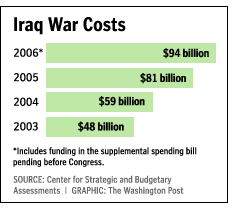 With the expected passage this spring of the largest emergency spending bill in history, annual war expenditures in Iraq continues to rise, from $48 billion in 2003, to $59 billion in 2004, to $81 billion in 2005 to an anticipated $94 billion in 2006, according to the Center for Strategic and Budgetary Assessments.
The U.S. government is now spending nearly $10 billion a month in Iraq and Afghanistan, up from $8.2 billion a year ago, a new Congressional Research Service report found.
Annual war costs in Iraq are easily outpacing the $61 billion a year that the United States spent in Vietnam between 1964 and 1972, in today's dollars.
The issue will be hotly debated next week when the Senate takes up a record $106.5 billion emergency spending bill that includes $72.4 billion for the wars in Iraq and Afghanistan. The bill is the fifth emergency defense request since the Iraq invasion in March 2003.
Army Chief of Staff Peter J. Schoomaker warned that such costs will continue, even after U.S. forces withdraw from Iraq. To fully re-equip and upgrade the U.S. Army after the war ends would cost $36 billion over six years. Sen. Jack Reed (D-R.I.), a member of the Armed Services Committee, said a more protracted fight could triple Schoomaker's $36 billion figure.
[Excerpts of an article by Jonathan Weisman, Washington Post]
4/21/06
The new Billion-Dollar Palace in Iraq
The fortress-like compound rising beside the Tigris River in Baghdad will be the largest of its kind in the world, the size of Vatican City, with the population of a small town, its own defense force, self-contained power and water. Original cost estimates range over $1 billion.
The new U.S. Embassy is as cloaked in secrecy as the ministate in Rome, and has been under construction since mid-2005 with a target completion date of June 2007. The embassy complex — 21 buildings on 104 acres, according to a U.S. Senate Foreign Relations Committee report — is taking shape just east of a former palace of Saddam Hussein’s and across the road from the building where the ex-dictator is now on trial.
"Embassy Baghdad" will dwarf new U.S. embassies elsewhere, its 104 acres six times larger than the United Nations compound in New York, and two-thirds the acreage of Washington's National Mall.
The 5,500 Americans and Iraqis working at the embassy, almost half listed as security, are far more numerous than at any other U.S. mission worldwide.
[Excerpts of an article by Charles J. Hanley, Associated Press]
The new U.S. Embassy is as cloaked in secrecy as the ministate in Rome, and has been under construction since mid-2005 with a target completion date of June 2007. The embassy complex — 21 buildings on 104 acres, according to a U.S. Senate Foreign Relations Committee report — is taking shape just east of a former palace of Saddam Hussein’s and across the road from the building where the ex-dictator is now on trial.
"Embassy Baghdad" will dwarf new U.S. embassies elsewhere, its 104 acres six times larger than the United Nations compound in New York, and two-thirds the acreage of Washington's National Mall.
The 5,500 Americans and Iraqis working at the embassy, almost half listed as security, are far more numerous than at any other U.S. mission worldwide.
[Excerpts of an article by Charles J. Hanley, Associated Press]
More on the new Billion-Dollar Palace in Iraq
"The presence of a massive U.S. embassy — by far the largest in the world — co-located in the Green Zone with the Iraqi government is seen by Iraqis as an indication of who actually exercises power in their country," says a European-based research group.
State Department spokesman Justin Higgins confirmed that “large numbers of non-diplomats work at the mission” — hundreds of military personnel and dozens of FBI agents, for example.
Security, overseen by U.S. Marines, will be extraordinary: structures reinforced to 2.5-times the standard, and five high-security entrances, plus an emergency entrance-exit, a Senate report says. It will have its own water wells, electricity plant and waste-water-treatment facility, "systems to allow 100 percent independence from city utilities," says the Senate report.
Factor into the equation that US engineers have been constructing 14 "enduring bases" in Iraq. This Pentagon-speak terminology, "enduring" bases, translates as something a little more enduring than a tent on a wooden platform. At least $4.5 billion has gone to construction and maintenance of U.S. bases.
Together, a one billion dollar “embassy” and 14 “enduring bases” suggest an indefinite stay on Iraqi soil that will cost US taxpayers for years to come. --Not to say that hopes that the troops might be out by 2008 is wildly optimistic.
State Department spokesman Justin Higgins confirmed that “large numbers of non-diplomats work at the mission” — hundreds of military personnel and dozens of FBI agents, for example.
Security, overseen by U.S. Marines, will be extraordinary: structures reinforced to 2.5-times the standard, and five high-security entrances, plus an emergency entrance-exit, a Senate report says. It will have its own water wells, electricity plant and waste-water-treatment facility, "systems to allow 100 percent independence from city utilities," says the Senate report.
Factor into the equation that US engineers have been constructing 14 "enduring bases" in Iraq. This Pentagon-speak terminology, "enduring" bases, translates as something a little more enduring than a tent on a wooden platform. At least $4.5 billion has gone to construction and maintenance of U.S. bases.
Together, a one billion dollar “embassy” and 14 “enduring bases” suggest an indefinite stay on Iraqi soil that will cost US taxpayers for years to come. --Not to say that hopes that the troops might be out by 2008 is wildly optimistic.
4/20/06
Two of three Brits want to leave charity legacies
The Remember a Charity consortium has published research suggesting that 68 per cent of UK adults want to leave their mark on the world by including a donation to charity in their wills.
The consortium, which includes more than 140 charities, commissioned its study through a market research agency to find out if people could be motivated to leave donations by the concept of 'leaving their mark'.
"The results are hugely encouraging," said Jonathan Parris, director of Remember a Charity. "Charitable legacies are the largest single source of voluntary income for UK charities."
The UK's biggest mortgage lender announced that the number of people subject to inheritance tax is set to triple by 2020, and predicts that 3.1 million more homeowners will be liable to legacy penalties within the next 15 years.
Because donations to charity fall outside the donor's estate for inheritance tax purposes, such donations can reduce inheritance tax and make more money available for other beneficiaries.
[thirdsector.co.uk]
The consortium, which includes more than 140 charities, commissioned its study through a market research agency to find out if people could be motivated to leave donations by the concept of 'leaving their mark'.
"The results are hugely encouraging," said Jonathan Parris, director of Remember a Charity. "Charitable legacies are the largest single source of voluntary income for UK charities."
The UK's biggest mortgage lender announced that the number of people subject to inheritance tax is set to triple by 2020, and predicts that 3.1 million more homeowners will be liable to legacy penalties within the next 15 years.
Because donations to charity fall outside the donor's estate for inheritance tax purposes, such donations can reduce inheritance tax and make more money available for other beneficiaries.
[thirdsector.co.uk]
4/19/06
Far Too Little British Philanthropy
The arrest of academy school advocate Des Smith in Scotland Yard's 'cash for honours' inquiry has been greeted with a bizarre degree of media glee.
We should all be wary of this culture of contempt for the entrepreneurs and businessmen who are generously donating to academy schools. For the truth is that we have far too little philanthropy.
As Major Bill Cochrane of the Salvation Army puts it: “There is a meanness abroad in society today. Barring a few high-profile exceptions, the rich in Britain give far too little of their money away.”
According to Colin Tweedy of Arts & Business: "The great age of industrial philanthropy is over. More and more now, it is a question of shareholder value."
The admirable Andrew Carnegie principle of distributing excess wealth 'best calculated to produce the most beneficial result for the community' is notably absent among our super-rich. The UK wealthy give less as a proportion of their income than the poor; they give substantially less than their peers in America; and they don't even begin to match their predecessors.
[From a commentary by Tristram Hunt, in the Guardian (U.K.)]
We should all be wary of this culture of contempt for the entrepreneurs and businessmen who are generously donating to academy schools. For the truth is that we have far too little philanthropy.
As Major Bill Cochrane of the Salvation Army puts it: “There is a meanness abroad in society today. Barring a few high-profile exceptions, the rich in Britain give far too little of their money away.”
According to Colin Tweedy of Arts & Business: "The great age of industrial philanthropy is over. More and more now, it is a question of shareholder value."
The admirable Andrew Carnegie principle of distributing excess wealth 'best calculated to produce the most beneficial result for the community' is notably absent among our super-rich. The UK wealthy give less as a proportion of their income than the poor; they give substantially less than their peers in America; and they don't even begin to match their predecessors.
[From a commentary by Tristram Hunt, in the Guardian (U.K.)]
4/18/06
Counting International Aid Dollars
Philanthropy flows to poor countries, some of it from famous outfits such as the Ford Foundation, and some unofficially from millions of ordinary givers.
A new study by the Hudson Institute concludes that U.S. private giving to poor countries came to a sum more than triple the U.S. government's foreign aid.
And nearly as large as the $80 billion given away by all donor governments combined.
By itself, official U.S. foreign aid comes to a minimal 0.17 percent of the gross domestic product, the second-lowest share among the 22 rich countries tracked by the Organization for Economic Cooperation and Development. Add in private philanthropy, and U.S. help to poor countries jumps to 0.61 percent of GDP, only slightly less than the 0.7 percent target urged by development advocates.
But who's giving most of this private aid?
Foundations, corporate philanthropic efforts, religious organizations and voluntary aid groups account for only about one third;
fully two-thirds comes from migrant workers sending money home. But these transfers, mainly within families, clearly aren't the same as "foreign aid" or even "charity."
Eliminate these remittances, and the United States doesn't stand out for its generosity.
A nation that wants to lead the world should invest more in the battle against poverty.
[From a Washington Post editorial]
A new study by the Hudson Institute concludes that U.S. private giving to poor countries came to a sum more than triple the U.S. government's foreign aid.
And nearly as large as the $80 billion given away by all donor governments combined.
By itself, official U.S. foreign aid comes to a minimal 0.17 percent of the gross domestic product, the second-lowest share among the 22 rich countries tracked by the Organization for Economic Cooperation and Development. Add in private philanthropy, and U.S. help to poor countries jumps to 0.61 percent of GDP, only slightly less than the 0.7 percent target urged by development advocates.
But who's giving most of this private aid?
Foundations, corporate philanthropic efforts, religious organizations and voluntary aid groups account for only about one third;
fully two-thirds comes from migrant workers sending money home. But these transfers, mainly within families, clearly aren't the same as "foreign aid" or even "charity."
Eliminate these remittances, and the United States doesn't stand out for its generosity.
A nation that wants to lead the world should invest more in the battle against poverty.
[From a Washington Post editorial]
4/17/06
Gates Foundation reorganizing for greater global outreach
The Bill & Melinda Gates Foundation plans to reorganize its top management structure into four programs intended to improve the philanthropy's overall mission of reducing global inequities.
Patty Stonesifer, chief executive officer of the Gates Foundation, announced in a statement that, as of May 1, the philanthropy's activities will be categorized into:
U.S. programs,
global health programs,
global development programs
and operations.
[The Seattle Post-Intelligencer]
Patty Stonesifer, chief executive officer of the Gates Foundation, announced in a statement that, as of May 1, the philanthropy's activities will be categorized into:
U.S. programs,
global health programs,
global development programs
and operations.
[The Seattle Post-Intelligencer]
4/16/06
Products Turn Red To Augment AIDS Funding
Help may be at hand in the form of Project Red, an effort conceived by U2 rock star Bono and the Kennedy clan's Bobby Shriver, who have worked together on African poverty issues. The project is centered on enlisting companies to create special "red" products, a portion of whose profits -- about 40% to 50% -- is given to the global AIDS fund for its work in Africa. "We're trying to make it really easy for people to help," Bono says, referring to consumers.
Mr. Annan's special U.N. envoy for AIDS in Africa, says, "The companies are going to benefit a hell of a lot more from Bono's name than the global fund is going to benefit from the companies."
Replies Bono, "We don't know that yet. If we fail, that's true."
The U.N. envoy for AIDS in Africa suggests that companies give 0.7% of their after-tax profits to the fund. But Ms. Tanguy of the HIV/AIDS business coalition says, "It's not going to happen," in part because shareholders likely wouldn't agree.
[By Steve Stecklow, The Wall Street Journal]
Mr. Annan's special U.N. envoy for AIDS in Africa, says, "The companies are going to benefit a hell of a lot more from Bono's name than the global fund is going to benefit from the companies."
Replies Bono, "We don't know that yet. If we fail, that's true."
The U.N. envoy for AIDS in Africa suggests that companies give 0.7% of their after-tax profits to the fund. But Ms. Tanguy of the HIV/AIDS business coalition says, "It's not going to happen," in part because shareholders likely wouldn't agree.
[By Steve Stecklow, The Wall Street Journal]
4/15/06
Corporation Non-Cooperation with AIDS Funding
When United Nations Secretary General Kofi Annan called in 2001 for a new global fund to fight the AIDS pandemic, he described it as a public-private partnership with both governments and corporations pitching in.
It hasn't worked out that way.
Since 2001, the Global Fund to Fight AIDS, Tuberculosis and Malaria, an independent Swiss-based, nonprofit foundation that is supporting disease prevention and treatment programs in 131 countries, has raised more than $4.8 billion from governments, including $1.5 billion from the U.S. Other money has come from nonprofit sources, including $150 million from the Bill and Melinda Gates Foundation.
But less than $2 million has come from corporations, and none of that has come from American companies, according to the fund's financial records. This isn't to say that U.S. companies ignore AIDS. Some have given to AIDS relief efforts outside the global fund -- more than $69 million in 2003, the latest year tracked by Funders Concerned About AIDS.
[By Steve Stecklow, The Wall Street Journal]
It hasn't worked out that way.
Since 2001, the Global Fund to Fight AIDS, Tuberculosis and Malaria, an independent Swiss-based, nonprofit foundation that is supporting disease prevention and treatment programs in 131 countries, has raised more than $4.8 billion from governments, including $1.5 billion from the U.S. Other money has come from nonprofit sources, including $150 million from the Bill and Melinda Gates Foundation.
But less than $2 million has come from corporations, and none of that has come from American companies, according to the fund's financial records. This isn't to say that U.S. companies ignore AIDS. Some have given to AIDS relief efforts outside the global fund -- more than $69 million in 2003, the latest year tracked by Funders Concerned About AIDS.
[By Steve Stecklow, The Wall Street Journal]
4/14/06
Afghanistan Opium: Between a rock and a hard place
There is a new spate of attacks in Afghanistan as NATO forces prepare to take over most military duties from the U.S.-led coalition. These attacks -- including suicide attacks, a tactic once unknown in Afghanistan – range “from the murders of five medical workers in Badghis province in the north to bombings in the opium poppy region of Helmand in the south”, as Pamela Constable reports in the Washington Post:
“The reinvigorated Taliban militia, for its part, has vowed to wage a bloody spring and summer offensive against the Afghan state. But a variety of foreign analysts and military officials here offer a different explanation: a vast canvas of weakly governed and unprotected territory in which drug traffickers, feuding tribesmen and opportunistic criminals -- as well as Taliban gunmen on motorbikes and mysterious suicide bombers -- operate with increasing ease, despite the presence of tens of thousands of foreign troops in the country.”
“Over the next several months, more than 6,000 troops from Britain and other NATO countries are slated to take over security in the southern region, and analysts are predicting a bloody debut.”
Another byproduct of Afghanistan occupation is the country is again producing 90 percent of the world's opium, which of course ends up on the streets of the world as heroin. According to one U.S. report, the area devoted to poppy production has nearly tripled in the last two years. One can understand why—drugs are about the only saleable commodity that poor country has.
The irony of this situation though is that the western occupying forces have become the chief drug lords there, in a way. After all, what made it possible for the smaller drug lords to come to power was the overthrow of the Taliban. In order to originally overthrow the Taliban, the U.S. had to turn to those Afghan rebels the Taliban were fighting—this shady bunch of warlords and drug lords called the Northern Alliance, whom the Taliban had driven from power because they were so corrupt.
The Taliban, who practice a very fervent and severe form of Islam, at least had cracked down on the opium growing and drug dealing during their reign of fear. To overthrow the Taliban, the U.S. used this alliance of drug dealers and warlords, and now the U.S. and NATO forces are between a rock and a hard place: The U.S. can't let the Taliban regain control but to keep the Taliban under control, they have to allow the Afghan drug lords and warlords, who are now provincial governors and even cabinet officials, keep dealing drugs and all their related chicanery.
“The reinvigorated Taliban militia, for its part, has vowed to wage a bloody spring and summer offensive against the Afghan state. But a variety of foreign analysts and military officials here offer a different explanation: a vast canvas of weakly governed and unprotected territory in which drug traffickers, feuding tribesmen and opportunistic criminals -- as well as Taliban gunmen on motorbikes and mysterious suicide bombers -- operate with increasing ease, despite the presence of tens of thousands of foreign troops in the country.”
“Over the next several months, more than 6,000 troops from Britain and other NATO countries are slated to take over security in the southern region, and analysts are predicting a bloody debut.”
Another byproduct of Afghanistan occupation is the country is again producing 90 percent of the world's opium, which of course ends up on the streets of the world as heroin. According to one U.S. report, the area devoted to poppy production has nearly tripled in the last two years. One can understand why—drugs are about the only saleable commodity that poor country has.
The irony of this situation though is that the western occupying forces have become the chief drug lords there, in a way. After all, what made it possible for the smaller drug lords to come to power was the overthrow of the Taliban. In order to originally overthrow the Taliban, the U.S. had to turn to those Afghan rebels the Taliban were fighting—this shady bunch of warlords and drug lords called the Northern Alliance, whom the Taliban had driven from power because they were so corrupt.
The Taliban, who practice a very fervent and severe form of Islam, at least had cracked down on the opium growing and drug dealing during their reign of fear. To overthrow the Taliban, the U.S. used this alliance of drug dealers and warlords, and now the U.S. and NATO forces are between a rock and a hard place: The U.S. can't let the Taliban regain control but to keep the Taliban under control, they have to allow the Afghan drug lords and warlords, who are now provincial governors and even cabinet officials, keep dealing drugs and all their related chicanery.
Subscribe to:
Posts (Atom)