2/21/06

Darfur, World's worst humanitarian crisis

Sudan has oil, and negotiations to share South Sudan’s oil wealth have been part of the issue between the Muslim north and the mainly Christian and animist south. It has spawned what the UN calls "the world's worst humanitarian crisis".

The historic conflict between Arabs and Africans is a recurring theme in Sudan, but it would be wrong to assume that it is always Arabs who are the victors, and Africans the vanquished.
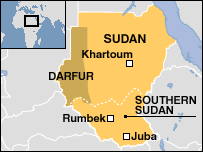
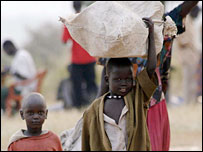
In camps for internally displaced people (IDP) in Darfur, where the United Nations' World Food Program (WFP) works, there are many examples of families and communities whose stories do not fit into simple stereotypes.

While the majority of the displaced are black Africans who have fled attacks by the Arab Janjaweed militia, there are also displaced Arab communities, whose villages were attacked by African groups, and who are victims of inter-African ethnic fighting. There are even parts of South Darfur where the WFP currently cannot work because of a dangerous traditional conflict between rival Arab groups.

The latest conflict began in early 2003, when two Darfur rebel groups took up arms against the Arab-led Islamic government in Khartoum, citing discrimination against the region's black tribes. The Sudanese government armed and organized a local Arab militia, known as the Janjaweed, to target local communities that were suspected of sympathizing with the rebels.

U.N. officials say as many as 200,000 people may have been killed by violence and disease as a result of the attacks.

2/20/06

Mr. Bush and Darfur Genocide

At least 2 million people -- a third of Darfur's population -- have been driven from their homes, and face starvation if international relief is interrupted. Assaults on civilians continue.

Having passed through three stages of denial on the Darfur issue, it appears that the Bush administration may finally be accepting United Nations Secretary General Annan's appeal for a more serious peacekeeping deployment.

For the last couple years, the Bush administration and its allies have clung to the fiction that they could stop the genocide in the Sudanese territory of Darfur by just sending in African Union forces.

Kofi Annan spoke the truth about these troops: "They didn't have the large numbers that would have been required for a region the size of Darfur. They didn't have logistical support."

This shouldn't even be a question. In 2004 Mr. Bush's administration sent expert investigators to interview 1,136 victims of Darfur's violence; based on this careful assessment, the administration accused Sudan's government of genocide -- the first time a government has leveled such an accusation at a sitting counterpart since the U.N. Convention on the Prevention and Punishment of Genocide was adopted in 1948.

This sickening violence was genocide when it began in 2003, and it remains so three years later. The excuses for not confronting it with a serious Western troop deployment never looked good, but they are now thinner than ever.

Darfur's violence has recently grown worse and has spread into neighboring Chad, a country that plays host to French troops and American oilmen and seems on the verge of a civil war fomented by rebels apparently linked to Sudan's military.

[Source: Washington Post Editorial]

related post

2/19/06

Charity a new concept in China

Over the last ten years, the average personal donation made by the Chinese population has been only 1.7 yuan (21 U.S. cents), the China Youth Daily quoted a source with the Children's Foundation of China as saying.

"Charity in China has much room for improvement and the government should reduce tax on donations to encourage more giving from companies," said Tian Di, director of the managing committee of the Foundation's minors' ideological and moral education branch.

No more than 100,000 Chinese companies, a mere one percent of the country's 10 million registered firms, have had a history in making donations to charity, according to the National Development and Reform Commission.

"China needs to create a credible, transparent and self-disciplined charity system with independent third-party evaluation which receives supervision from government, media and all of society," the newspaper quoted Tian as saying. "People can be confident about where their donation goes if the charity organization has a high credibility."

It is estimated that by the end of 2004, about 5 billion yuan (617 million U.S. dollars) had been donated to China's charitable organizations, accounting for 0.05 percent of the gross domestic product. In comparison, it was 2.17 percent in the United States

[Source: Xinhuanet]

2/18/06

Scots top charity givers in the UK

It seems Scots are more likely than the rest of the UK to give to charity, with one in three prepared to donate, compared with one in four south of the border. Oxfam say its due to events such as the tsunami and the Asian earthquake.

News coverage of disasters and the aftermath hit a worldwide audience and it seems Scots were particularly affected.

Judith Robertson from Oxfam Scotland said "I think the events of 2005 have mobilized people. The make poverty history march in Edinburgh, the fact that G8 was in Scotland and 250 000 people marched there. People were energized and encouraged to do more and I think particularly in Scotland."

The research also shows that women are more generous than men with one in four donating money each month compared with one in five men.

Oxfam say while it's always important that people put their money where their mouth is, it is also crucial that they do not just give their cash but consider donating their time as well perhaps as a volunteer.

Source: Scotland Today

2/17/06

Aussie Charity

After a lengthy period of economic prosperity, more Australians than ever before are in the happy position of having more money than they need to live on themselves or hand on to the kids. As far as distributing this wealth to those less fortunate, government incentives are making an impact but we could still do better.

Western Pacific financial adviser Ivan Ang believes many people want to do more with their wealth to make a difference to society. He points to a trend among clients already giving to charity who reach a point where they want to move beyond cheque-book philanthropy to a more strategic giving plan.

A report released by the Prime Minister's Community Business Partnership committee recently estimated that Australian individuals and businesses gave $11 billion to charity in 2004. Yet the amount we give as a proportion of GDP is just 0.5 per cent, well behind the US at 2.1 per cent and trailing Britain at 0.77 per cent.

The Federal Government has given philanthropy a boost with the introduction of tax-effective vehicles for giving, notably prescribed private funds, introduced in 1999. There are more than 350 such funds, with a combined kitty of more than $400 million.

[Excerpt of an article by Barbara Drury, The Sydney Morning Herald]

2/16/06

Aid to Afghanistan 4 Years Later

A high-level, 60-nation meeting was held in London to assess the state of Afghanistan four years after the Taliban was ousted. Participants judged that the country was doing reasonably well and pledged an additional $10.5 billion over five years to help it further along.

The principal dilemma is the narcotics production and marketing, with as much as 90 percent of the world's heroin and opium again coming from Afghanistan. The Taliban government had pretty much wiped the drug trade out prior to 2001 but it's now back in full production.

The second major problem, also examined at the conference, is the lack of control that the central government of President Hamid Karzai has over Afghanistan, a country the size of Texas, which retards the development of national unity.

As to economic aid, which is critical to enhancing the credibility of the Karzai government, the United States will provide $1.1 billion in 2006 and seek the same amount from Congress for 2007. It has also found its promises of economic reconstruction aid hard to keep, given the difficult security climate there.

The United States plans to draw down its military presence in Afghanistan from about 19,000, currently costing about $800 million a month.

So it costs close to billion a month to keep U.S. troops in Afghanistan, or $9.6 Billion a year.

And meanwhile the U.S. gives the country a billion a year in aid, which is just over 11% of the amount spent on military operations.

Source: Pittsburgh Post-Gazette

2/15/06

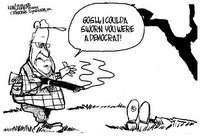
Cheney's quail-hunting accident

Cover-up or overblown? What did you see when you saw the story about Vice-President Cheney's hunting accident?

If you were a comedy writer, you saw definitive proof of the existence of God.

If you hold the Bush Administration in minimum high regard, you saw enough metaphors to power a Ph.D. thesis: a reckless, inept use of force directed at the wrong target, compounded by a cover-up.

There are plenty of grounds on which to make out a case against the vice president's performance in office; there are plenty of examples where his easy assurances -- about weapons of mass destruction, about the way the U.S. would be greeted in Iraq -- have turned out to be dramatically wrong-headed. But I'd prefer to see those arguments stand or fall on their merits.

As for the comedy writers, they're exempt from any analysis, rigorous or otherwise. Some temptations are, literally, irresistible.

[Excerpt of CNN story by Jeff Greenfield, CNN Senior Analyst]

Sample Cheney Jokes

· "Good news, ladies and gentlemen, we have finally located weapons of mass destruction: It's Dick Cheney."
· "We can't get Bin Laden, but we nailed a 78-year-old attorney."
· "But here is the sad part -- before the trip Donald Rumsfeld had denied the guy's request for body armor." --"Late Show with David Letterman," CBS

· "I think Cheney is starting to lose it. After he shot the guy he screamed, 'Anyone else want to call domestic wire tapping illegal?' " "The Tonight Show with Jay Leno," NBC

· "Now, this story certainly has its humorous aspects. ... But it also raises a serious issue, one which I feel very strongly about. ... Moms, dads, if you're watching right now, I can't emphasize this enough: Do not let your kids go on hunting trips with the vice president. I don't care what kind of lucrative contracts they're trying to land, or energy regulations they're trying to get lifted -- it's just not worth it." --"The Daily Show with Jon Stewart," Comedy Central

· "The big scandal apparently is that they didn't release the news for 18 hours. …Apparently the reason they didn't release the information right away is they said we had to get the facts right. That's never stopped them in the past." --"Late Late Show with Craig Ferguson," CBS

2/14/06

Iraqi War Bush budget buster

President Bush submitted a budget to Congress this past week that is so big, most of us just shrug it off without thinking about what it means to us individually. Think about this:

• The $2.77 trillion budget for the fiscal year starting in October breaks down to an average of $9,293.62 for everyone in the USA.

• The latest budget request for Iraq of about $96 billion brings the cost of that war to $322 billion, an average of $1,080.34 per person.

If you think big business or somebody else will pay the bill, think again. About 45% of the federal government's revenue comes from individual income taxes.

Paying more for education, health care, Social Security, real "homeland security" and … decent pay for servicemen and women doesn't bother me. But Bush simply can't convince me on continuing the cost in Iraq - in dollars and, more important, in precious lives -for a war that he never should have started.

[From editorial by Al Neuharth, founder of USA Today]

2/13/06

Food as a Commodity

When food is treated as a commodity, only those who can afford to pay for it get food.. To illustrate this further, the following is worth quoting at length:

To understand why people go hungry you must stop thinking about food as something farmers grow for others to eat, and begin thinking about it as something companies produce for other people to buy.

Much of the best agricultural land in the world is used to grow commodities such as cotton, sisal, tea, tobacco, sugar cane, and cocoa, items which are non-food products or are marginally nutritious, but for which there is a large market.

Millions of acres of potentially productive farmland is used to pasture cattle, an extremely inefficient use of land, water and energy, but one for which there is a market …in wealthy countries.

More than half the grain grown in the United States (requiring half the water used in the U.S.) is fed to livestock, grain that would feed far more people than would the livestock to which it is fed.

The problem, of course, is that people who don’t have enough money to buy food -- and more than one billion people earn less than $1 a day -- simply don’t count in the food equation.

What this means is that ending hunger requires doing away with poverty, or, at the very least, ensuring that people have enough money or the means to acquire it, to buy, and hence create a market demand for food.

— Richard H. Robbins, Readings on Poverty, Hunger, and Economic Development

2/12/06

Some Aid doesn’t aid at all

Jean-Bertrand Arisitde points out:

Many in the First World imagine the amount of money spent on aid to developing countries is massive. In fact, it amounts to only .03% of the GNP of the industrialized nations.

Additionally, For every dollar the United States puts into the World Bank, an estimated $2 actually goes into the US economy in goods and services.

Meanwhile, severely indebted low-income countries pay one billion dollars more in debt and interest to the International Monetary Fund (IMF) than they receive from it.

For the 46 countries of Sub-Saharan Africa, foreign debt service was four times their combined governmental health and education budgets.

So, we find that some aid does not aid.

- Jean-Bertrand Aristide, Eyes of the Heart; Seeking a Path for the Poor in the Age of Globalization

2/11/06

Blaming the Victim

A common theme on international aid issues has been to “blame the victim”.

Following are some common “myths” often used to highlight such aspects, including (and quoting):

1. Africa has received increasing amounts of aid over the years
— IN FACT, aid to Sub-Saharan Africa fell by 48% over the 1990s

2. Africa needs to integrate more into the global economy
— IN FACT, trade accounts for larger proportion of Africa’s income than of the G8

3. Economic reform will generate new foreign investment
— IN FACT, investment to Africa has fallen since they opened up their economies

4. Bad governance has caused Africa’s poverty
— IN FACT, according to the UN Conference on Trade and Development, economic conditions imposed by the IMF and the World Bank were the dominant influence on economic policy in the two decades to 2000, a period in which Africa’s income per head fell by 10%, and income of the poorest 20% of people fell by 2% per year.

Christian Aid weighs in on this with a more recent report noting that sub-Saharan Africa is a massive $272 billion worse off because of “free” trade policies forced on them as a condition of receiving aid and debt relief.

The reforms that rich countries forced on Africa were supposed to boost economic growth. However, … they were left worse off.

The economics of failure: The real cost of ‘free’ trade', Christian Aid, June 20, 2005

[From MAKEpovertyHISTORY.org]

2/10/06

Quality of Aid from Rich Countries

At last year’s G8 Summit, much was made about “historic” debt write-offs and other huge amounts of aid. The media and government spin implied the problem was that aid often gets wasted and thus should only be delivered to poor countries if they meet certain conditions and demands.

Yet, hardly ever addressed in the mainstream discourse is the quality of aid of from rich countries. Following is an excerpt from a briefing prepared for a G8 summit by Action for Southern Africa and the World Development Movement, looking at the wider issue of economic and political problems:

"It is undeniable that there has been poor governance, corruption and mismanagement in Africa.

However, the briefing reveals the context — the legacy of colonialism, the support of the G8 for repressive regimes in the Cold War, the creation of the debt trap, the massive failure of Structural Adjustment Programmes imposed by the IMF and World Bank and the deeply unfair rules on international trade.

"The role of the G8 in creating the conditions for Africa’s crisis cannot be denied. Its overriding responsibility must be to put its own house in order, and to end the unjust policies that are inhibiting Africa’s development."

Source: globalissues.org

2/9/06

The Cycle of Poverty and Powerlessness

The poorest people in the world are trapped in a cycle of poverty and powerlessness. This is perpetuated, at least in part, by the unremitting demands of the rich nations for money from the poor nations in debt payments.

Where did the debt come from? From the 1960s and 1970s,deveopling countries were encouraged to take on large loans, which since then has escalated into enormous and unmanageable debts.

Many countries now owe more than their original loans, even after years of repayments.

Every day, poor countries give over $100 million in debt service to rich countries and the institutions they control such as the World Bank and International Monetary Fund (IMF). For every $1 they receive in grant aid, they pay back more then $3 in debt service.

Meanwhile, 30,000 children are dying every day because of preventable poverty—that is from hunger, lack of clean water, and diseases that could be prevented or treated if the money was available.

[Source: Paper For World Debt Day 2005, written by Caroline Pearce, Romilly Greenhill and Jonathan Glennie]

2/8/06

Aid and Militarism

President Bush sent Congress a $2.77 trillion spending plan last Monday that would bolster the nation's War against Terrorism but squeeze many domestic government programs which will directly impact America’s quality of education and health.

Similar to patterns during the Cold War, the War on Terrorism (aka The Long War) will affect how much is spent internationally and what aid goes where.

For example:
>The total foreign aid proposal ... amounts to a mere percent of what Bush is requesting for the Pentagon.
>Where Bush’s foreign-aid plan appears to mark an increase over previous levels, much of the additional money is explained by greater spending on security for US embassies and personnel overseas.
>Credit for foreign militaries to buy US weapons and equipment will increase to the highest total in well over a decade. (An example of “aid” benefiting the donor!)
>Such military aid will come largely at the expense of humanitarian and development assistance.

The European Union is linking aid to fighting terrorism as well, with European Ministers warning countries that their relations with the economically powerful bloc will suffer if they fail to cooperate in the fight against terrorism. An EU official is quoted as saying, “aid and trade could be affected if the fight against terrorism was considered insufficient”, leading to accusations of “compromising the neutrality, impartiality and independence of humanitarian assistance”.

2/7/06

Hamas Seeking New Means of Aid

A senior Hamas official said the Islamic militant group is looking for new sources of funding after the international community threatened to cut off aid.

"We are looking for alternative sources and we will not allow ourselves to be blackmailed," Osama Hamdan said in a telephone interview with The Associated Press from Beirut, Lebanon. "We will not accept any conditions from anybody. At the same time, we are ready for dialogue."

Hamas leaders, who have tried to portray a more moderate image since the election, sought to assure the donors that aid would go only to ordinary Palestinians and not be used for attacks.

Analysts say that although most wealthy Persian Gulf nations — and even the West — will not stand by and watch the Palestinians starve, the Arab and Muslim world is unlikely to provide the kind of cash Western nations have given.

Iran is another possible benefactor. Already believed to fund the Lebanese guerrilla group Hezbollah, the Islamic Republic congratulated Hamas on its victory and appeared ready to chip in. Hamas also collects donations from Islamic charities and communities around the world, especially Indonesia, Malaysia and Saudi Arabia, where people give generously during collection drives after Friday prayers.

"The West doesn't want to give money to Hamas, but it doesn't want the (Palestinian Authority) to collapse either, (knowing) the deepened human misery

[By Mohammed Daraghmeh and Lara Sukhtian, Associated Press]

2/6/06

U.N. adviser: West is killing Africa with gun sales

A senior United Nations aid official called on Thursday for a halt to arms sales to Africa, saying it would be more effective in addressing the continent's poverty than charity rock concerts or debt relief.

Dennis McNamara, special U.N. adviser on internal displacement, slammed world powers for neglecting some 12.5 million Africans uprooted within their countries, who form half of the world's internally displaced persons (IDPs).

He accused the West of supplying the weapons fuelling African conflicts which leave civilians homeless -- and prey to war crimes, hunger, disease and rape -- while greedy companies exploit the oil and mineral wealth.

"Guns are at the heart of the problem ... There is one slogan I would like to suggest for 2006: No Arms Sales to Africa. Zero. Not an embargo, not a sanction, a voluntary cessation of all arms sales to Africa," McNamara told a news briefing.

"The kids on the streets of Nairobi, Khartoum, Abidjan and Monrovia have guns in their pockets or up their sleeves ... We provided the arms. We the West, we the G8," he added, referring to the Group of Eight industrialized nations.

[Reuters]

2/5/06

So far the Iraqi War has cost each family of four $3000

Iraq’s Civil War has cost every family in the United States $3000 – so far.

God forbid critics of the war on Iraq should compare it with the war in Vietnam. But perhaps it is worth mentioning that the liberation of Iraq is now costing more each month than the preservation of the Republic of South Vietnam did more than 30 years ago.

As the admitted direct cost of the war reached $250 billion last week -- and the White House asked for $120 billion more on Thursday -- new analyses estimate that the invasion of Iraq could end up costing $2 trillion before it is over.

If you remember, the White House's own economic adviser, Lawrence Lindsey, was fired for predicting, in September 2002, six months before the invasion, that the total cost of the war might reach between $100 billion and $200 billion. What I (and perhaps others who questioned the wisdom of the war before it began) remember is the hundreds of e-mails and letters I received after I quoted Lindsey and used the higher figure as more likely. "Moron" and "traitor" were among the more polite epithets of the day.

[Excerpt of Yahoo News Opinion column written by journalist Richard Reeves] related post

Original Cost of Iraqi War was $75M, not $2 Trillion

Numbers can be misleading, of course. Some, such as the long-term cost of treating damaged survivors of battle, can be exaggerated or minimized. Some can be hidden in other budgets or drawn from confusing off-budget accounts.

But the exact figures are not the issue. The Washington issue is that the Bush administration has been lying from day one about the cost of this "preventative" war of choice. The original White House estimate of the total war cost was $75 billion, including the destruction of all Iraqi "weapons of mass destruction."

Undersecretary of Defense Paul Wolfowitz, whose fiscal acumen won him the presidency of the World Bank , even offered the theory that the war would be self-financing, paid for by Iraq's oil production. That's rich. And so are oil producers everywhere.

The war, in fact, is a factor in the escalating cost of petroleum products here and everywhere else in the world. Leaving that aside as you watch the gas-pump digits rise to Super Bowl numbers this weekend, two anti-war research institutes, the International Relations Center and the Institute for Policy Studies, estimate that the war's cost per citizen has reached $727 -- or close to $3,000 for a family of four.

By the end of this year, those figures should reach about $1,300 per citizen, or more than $5,000 for that family of four.

[Excerpt of Yahoo News Opinion column written by journalist Richard Reeves] related post

What else we could have bought instead of War

Journalist Richard Reeves writes that the cost of the Iraqi War --just to date— could have “provided health care for 46 million Americans without health insurance, the hiring of 3.5 million elementary school teachers, or the construction of 2 million units of affordable housing”.

Pertaining to the theme of this blog, here’s a couple other things that could be on the shopping list if the investments in relieving suffering were applied internationally:

$200 Million could wipe out basic diseases that together kill 4 Million children every year. (Note that the cost of building the new U.S. Embassy in Iraq in itself cost 3 times as much --just under $600 Million!)

$40-$70 Billion is the figure that UNICEF concludes could totally reduce poverty, conflict and HIV/AIDS and improve the plight of the world's children.

See also

2/4/06

Global Killer Disease - Not AIDS but Apathy

Of diseases rampant in the Third World, AIDS gets the most attention and focus. Not coincidentally, it is also one of the few diseases that remain a threat to First World countries.

While other diseases do not get anywhere as much media attention as AIDS, there are other completely preventable diseases that afflict the world’s poor to a greater degree than AIDS.

While AIDS is believed to have claimed over 3 million lives in 2005 alone, a total of 11 million people have been estimated killed by infectious diseases like malaria, TB and measles.

These basic diseases kill far more people than wars, but attract less media attention.

Furthermore, it seems they also attract less attention because the people affected are from poor countries.

While many of these diseases have long been recognized as resulting from poverty, some are now contributing to poverty.

I repeat this point: Eleven million people in poor countries will die from infectious diseases this year, and many of these diseases are easily preventable. --While the nations of the World are too busy investing billions into weapons and defense budgets to notice --or care.

Put a different way, by the time you finish browsing blogs 100 people will have died. Half of them will be children under age five.

2/3/06

Disease: A larger killer than conflicts

Consider the following:
o One billion people lack access to health care systems
o About 11 million children under the age of 5 die from malnutrition and mostly preventable diseases, each year
o Almost 11 million people died of infectious diseases alone … far more than the number killed in the natural or man-made catastrophes that make headlines.

Re: AIDS/HIV, UNAIDS estimates for 2005 that there are:
o 40 million living with HIV (most in Africa, 25.8 million)
o 4.9 million new HIV infections in 2005 (mostly in Africa, 3.2 million)
o 3.1 million AIDS deaths in 2005, (mostly in Africa, 2.4 million)

Tuberculosis kills 1.75 million people each year, with 8.8 million new cases a year, as the World Health Organization (WHO) points out. In addition,
o Someone in the world is newly infected with TB bacilli every second.
o Overall, one-third of the world’s population is currently infected with the TB bacillus.
o 5-10% of people who are infected with TB bacilli (but who are not infected with HIV) become sick or infectious at some time during their life.

TB is a leading cause of death among people who are HIV-positive. It accounts for about 13% of AIDS deaths worldwide. In Africa, HIV is the single most important factor determining the increased incidence of TB in the past 10 years.
Tuberculosis, World Health Organization, Fact Sheet No 104, April 2005

[Anup Shah] related post

2/2/06

One Million die from Malaria

Consider the impacts of malaria:

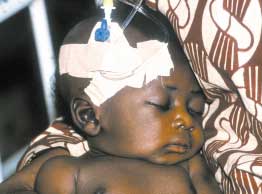
Malaria causes more than 300 million acute illnesses and at least 1 million deaths, annually.

3000 children per day in Africa die from malaria, almost one every 30 seconds.

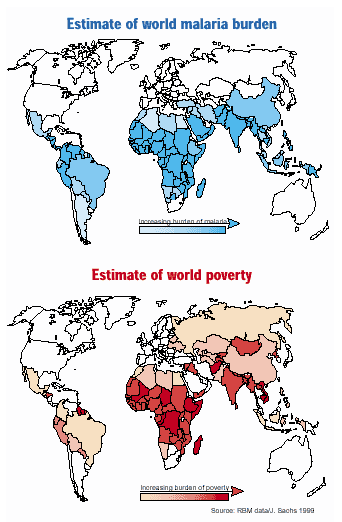
Malaria is both a disease of poverty and a cause of poverty, as the WHO also notes. Furthermore,

Malaria has significant measurable direct and indirect costs, and has recently been shown to be a major constraint to economic development.… The indirect costs of malaria include lost productivity or income associated with illness or death.

Malaria also hampers children’s schooling and social development through both absenteeism and permanent neurological and other damage associated with severe episodes of the disease.

The risk of contracting malaria in endemic areas can deter investment, both internal and external and affect individual and household decision making in many ways that have a negative impact on economic productivity and growth.

Source: Economic costs of Malaria, World Health Organization, November 27, 2005

[Anup Shah]

More Killers: Measles and Typhoid

An issue that is rarely covered by the mainstream media is the sheer number of people affected and dying from tropical and infectious diseases—and that this is largely preventable and curable.

More than half a million people, the majority of them children, died from measles in 2003 (the latest years for which figures are available, at time of writing), according to the WHO.

This is despite the fact that effective immunization, which includes vaccine and safe injection equipment, costs just 0.30 US dollars (30 cents) and has been available for more than 40 years.

Additionally, an estimated 600,000 people die from typhoid each year

[Anup Shah]

2/1/06

Global Study Examines Toll of Genetic Defects

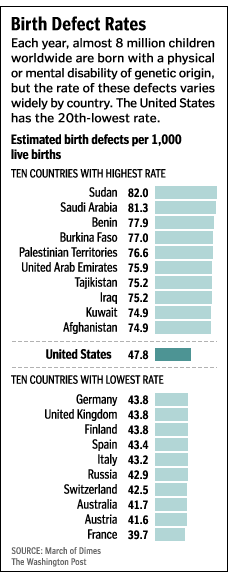
About 6 percent of children worldwide -- nearly 8 million babies a year -- are born with a physical or mental disability caused by a genetic defect, according to the first comprehensive estimate of the global toll.

Each year, about 3.3 million of them die before their fifth birthday, victims of what the report's authors call a "serious and vastly unappreciated public health problem."

Although parents everywhere face some risk of having a child with a defect, the risk is much greater in poor and middle-income countries. Reasons include inadequate maternal health and prenatal care, more intermarriage, and a higher frequency of some disease-causing genes.

The experience in rich countries over the past quarter-century, however, suggests that 70 percent of these defects can be prevented or lessened.

The authors of the report, which was sponsored by the March of Dimes, hope it will be the first step in convincing countries that birth defects are neither inevitable nor untreatable.

[By David Brown, Washington Post]

Global Study on Genetic Defects

A new 85-page report on genetic defects spans the rate of defects per 1,000 births, ranging from 82 in Sudan and 81 in Saudi Arabia at the high end, to 40 in France and 42 in Austria. The United States has the 20th-lowest rate, with 48.

Affluence is a big determinant of the risk. In low-income countries, the average rate is 64; in middle-income countries, 56; and in rich countries, 47.

Interventions proven to work are unavailable in low-income countries.

With the help of a grant from the March of Dimes, geneticists at the University of Witwatersrand in Johannesburg are developing a course to teach nurses and birth attendants the rudiments of medical genetics and how to examine newborns for common birth defects.

[By David Brown, Washington Post]

1/31/06

An "Award" Corporations Don't Want to Win

The annual meeting at Davos, Switzerland organized by the World Economic Forum (WEF) usually brings juicy benefits for transnational corporations, except for a handful that are singled out for a dubious distinction by civil society groups: the Public Eye Awards for irresponsible corporate behavior.

Nominees for the Awards this year include Alcoa, Bayer, Coca Cola, Chevron, Novartis, Walt Disney, Citigroup and Nestlé.

The Awards are aimed at highlighting particularly irresponsible behavior on the part of corporations in the areas of the environment, labor rights, human rights and taxes.

The Award winners are selected from nominees proposed by non-governmental organizations from around the world. The negative Awards are aimed at simultaneously counteracting the influence of the WEF, and to contribute to a debate on the darker zones of globalization that is merely profit-oriented. The goal is to make a point that transnational corporations should be subjected to binding international rules that force them to accept legal responsibility and accountability for their actions, and when it is warranted, punishment.

Two international non-governmental organizations, Pro Natura - Friends of the Earth Switzerland and the Berne Declaration organize the event. Pro Natura, Switzerland's largest environmental group, with some 100,000 members and 45,000 donors, is a non-profit, non-governmental organization founded in 1909. For its part, the Berne Declaration, based in the Swiss capital, was founded in 1968 to promote more just, sustainable and democratic North-South relations.

[Gustavo Capdevila, ipsnews.net]

1/30/06

US Congress discuss aid for Global Pandemics

In the confusion of this post-Cold War, terrorist-troubled world, Congress is betting more and more foreign aid dollars on fighting that one common foe everyone can agree upon: infectious disease.

"Medicine can be a currency for peace" says Senate Majority Leader Bill Frist, a surgeon and a force behind the change. The increase parallels -- and is energized by -- efforts by private philanthropists like billionaire Bill Gates, who pledged Friday to triple his contributions to fight tuberculosis.

Mr. Frist's involvement begins with his medical background, including missions to Africa. As Sen. Frist uses his office and medical credentials to promote public focus on battling disease, the Bill and Melinda Gates Foundation estimates it has committed $6 billion to global health initiatives. The foundation also has promised to increase spending against tuberculosis over the next decade to $900 million from $300 million.

"People question if the government can do it all," Sen. Frist says. "To have the private sector step up and lead in targeted areas captures synergies that otherwise wouldn't be there. I think it's critically important. I really applaud him."

[Excerpt from an article by David Rogers, The Wall Street Journal]

1/28/06

Your Tax Dollars at Work

A just published U.S. government audit of its spending of aid on Iraqi reconstruction reveals incredible irregularities and improprieties, including tens of millions of dollars in cash deposited and withdrawn from a vault without any tracking documentation and up to $60,000 in reconstruction funds gambled away by an American soldier.

U.S. officials "did not effectively manage" more than 2,000 contracts worth $88 million, according to the report by the Special Inspector General for Iraq Reconstruction, which covered spending during 2003 and 2004 in six southern and central provinces.

In one Iraqi city, the United States paid $108,140 for renovations that were never made to an Olympic-size swimming pool. And signed off on repairs to an elevator in the city's general hospital that later crashed to the ground, killing three people.

Read full New York Times article

1/27/06

The Realities of Exporting Democracy

President Bush made “the spread of democracy” his Administrations’ primary mission. But soaring rhetoric has often clashed with geopolitical reality and competing U.S. priorities.

Beyond its focus on Iraq, Washington has stepped up pressure on repressive regimes in countries such as Belarus, Burma and Zimbabwe -- where the costs of a confrontation are minimal -- while still gingerly dealing with China, Pakistan, Russia and other countries with strategic and trade significance.

In the Middle East, where the US administration has centered its attention, it promoted elections in the Palestinian territories, even as it directed money aimed at clandestinely preventing the radical Islamic group Hamas from winning. [Regardless, Hamas won, snatching power from the ruling old guard Fatah, taking a 76 seat majority in the 132-seat Palestinian Legislative Council.]

And although it has now suspended trade negotiations with Egypt, it did not publicly announce the move, nor has it cut the traditionally generous U.S. aid to Cairo.

[Washington Post]

1/26/06

Egypt, 2nd Largest Aid Recipient

After Israel, the U.S.’s next largest aid recipient is Egypt.

How does democracy fare there? Following are excerpts from a recent Washington Post article:

Sitting in a prison cell halfway around the planet, an Egyptian opposition leader forced President Bush this month to confront the question of how serious he was when he vowed to devote his second term to "ending tyranny in our world."

Ayman Nour, who dared challenge Egypt's authoritarian leader [Hosni Mubarak] in manipulated elections, was sentenced on Christmas Eve to five years on what U.S. officials consider bogus charges.

President Hosni Mubarak agreed to let challengers run against him for the first time , a visiting Laura Bush praised the "wise and bold" move. But shortly after she left, Mubarak supporters orchestrated attacks on democracy demonstrators. The presidential election was manipulated, and a subsequent parliamentary election degenerated into violence and mass arrests.

The arrest of Nour [who ran] against Mubarak presented a singular challenge to Bush, who promised in his inaugural address to stand with "democratic reformers facing repression, prison or exile." The White House pronounced itself "deeply troubled" and demanded Mubarak "release Mr. Nour from detention."

Nour remains behind bars.


UPDATE May 2006:
CAIRO, May 18 -- An appeals court on Thursday upheld the fraud conviction of Ayman Nour, the candidate who challenged President Hosni Mubarak and his 25 years of one-man rule in elections last year, effectively consigning the fiery lawyer to five years in prison.

2/3rds of US Aid goes to Israel and Egypt

While the total amount of aid given by the US might look very generous,

“US Senator Patrick Leahy noted that two-thirds of US government aid goes to only two countries: Israel and Egypt.”

[As stated at World Economic Forum in New York, February 2002]

US Aid to Palestine -- for Democracy

The Bush administration is spending foreign aid money to increase the popularity of the Palestinian Authority on the eve of crucial elections in which the governing party faces a serious challenge from the radical Islamic group Hamas.

The approximately $2 million program is being led by a division of the U.S. Agency for International Development. But no U.S. government logos appear with the projects or events being undertaken. U.S. officials say their low profile is meant to ensure that the Palestinian Authority receives public credit for a collection of small, popular projects and events to be unveiled before Palestinians select their first parliament in a decade.

U.S. officials say they fear the election will result in a large Hamas presence in the 132-seat legislature. Hamas is classified by the U.S. government as a terrorist organization. But its reputation for competence and accountability in providing social services has made it a stiff rival of the secular Fatah movement, which runs the Palestinian Authority and has long been the largest party in the Palestinian territories.

The program highlights the central challenge facing the Bush administration as it promotes democracy in the Middle East. But in attempting to manage the results, the administration risks undermining the democratic goals it is promoting.

P.S. - Hamas ended up unseating the U.S. backed favorite, winning a major number of seats in the Palestinian legislative process, with 77 percent of the 1.3 million registered Palestinian voters casting ballots

[Washington Post]

Israel largest recipient of US aid

Israel, a country of 3 million, is the largest recipient of US aid of any country in the world.

Since 1987, the US Congress has annually been approving a foreign aid bill totaling an average of $3 billion of American taxpayers' money to Israel: $1.2 billion in economical aid, and $1.8 billion in military aid.

After the 1973 war, the US aid to Israel constituted largely of military and economic grants to help strengthen the Israeli defense forces. This included $12-80 million, which was annually granted towards the establishment of Jewish settlements.

Since the gulf war in 1991, the US has additionally been offering Israel $2 billion annually in federal loan guarantees, which brings the total US foreign aid to Israel to about $5 billion, or $13.7 million per day.

Nearly all past loans to Israel have been forgiven – leading Israel to claim that they have never defaulted on repayment of a US loan – with most loans made on the understanding that they would be forgiven before Israel was required to repay them.

Other forms of aid to Israel are a result of "consequential" aid, such as the approximate $1.5 billion in total tax-deductible private donations from numerous Jewish charities and individual donors. The ability of Americans to make what amounts to tax deductible contributions to a foreign government (Israel) does not exist for any other country.

Including "consequential" aid to Israel this adds up to an approximate $8 billion in total US foreign aid annually to Israel.

All in all, this is the largest amount of foreign aid given to a country, and constitutes over 30% of the total amount of US foreign aid budget.

Israel’s population comprises just .001% of the world’s population and has one the world’s higher per capita incomes.

[Source: The Washington Report on Middle East Affairs]